






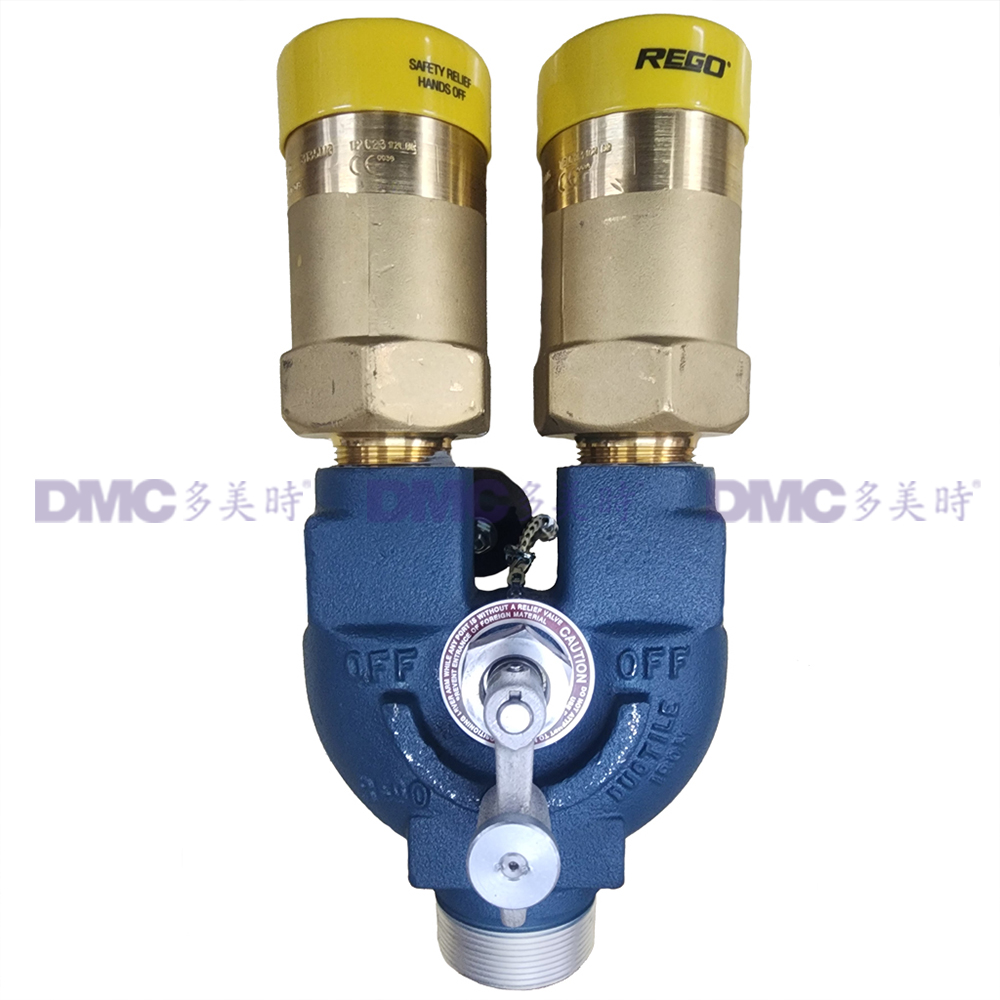
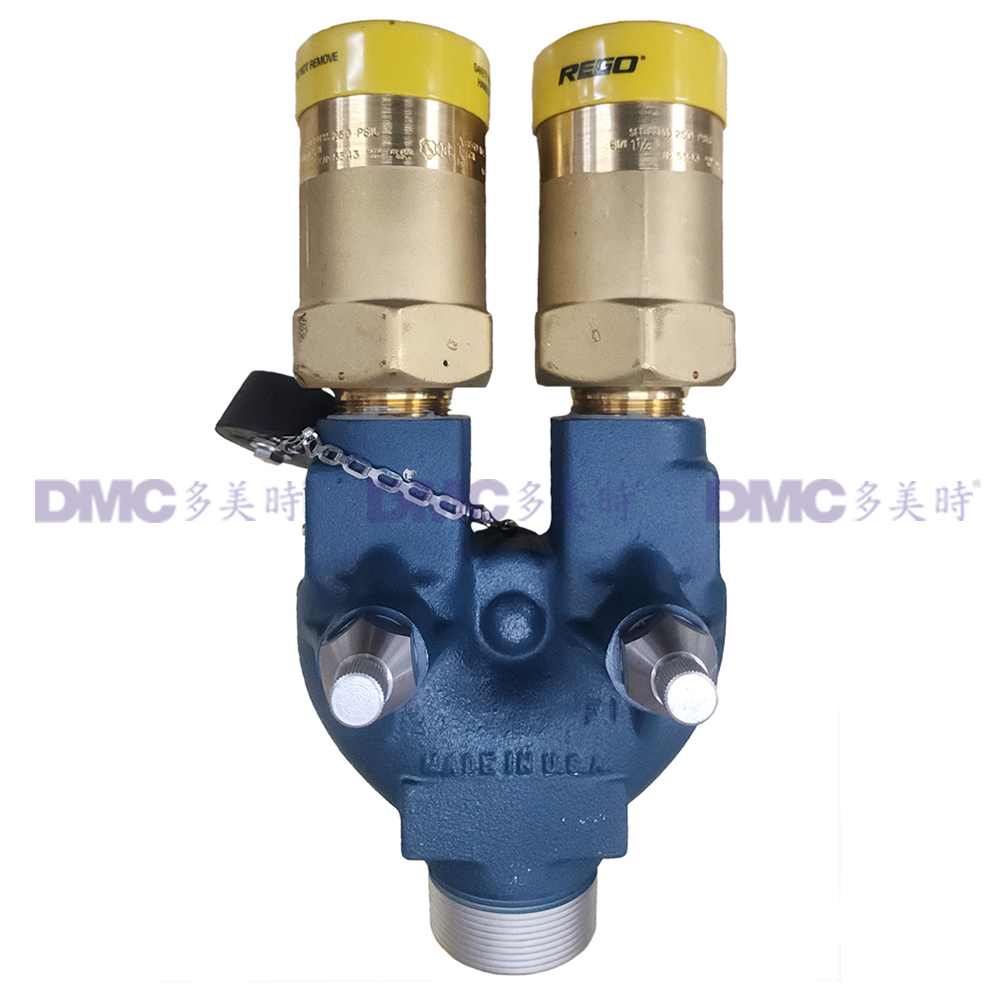
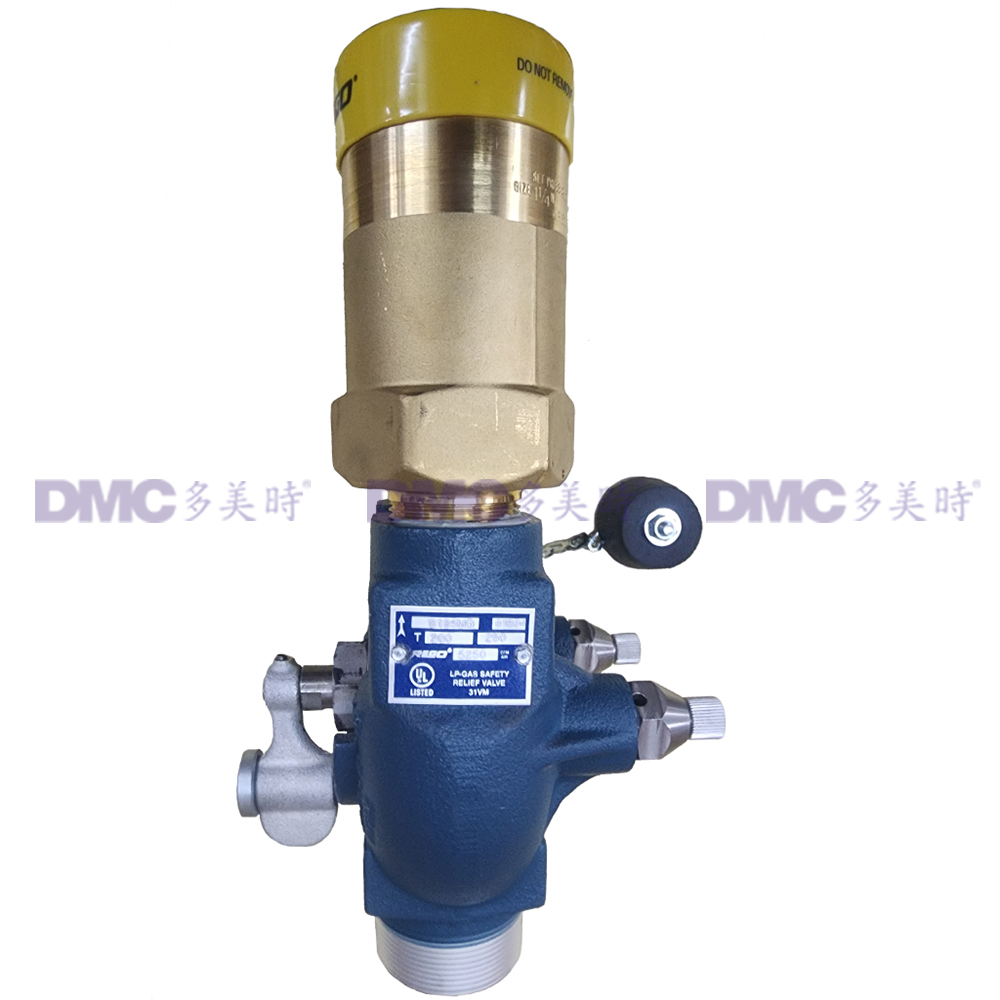
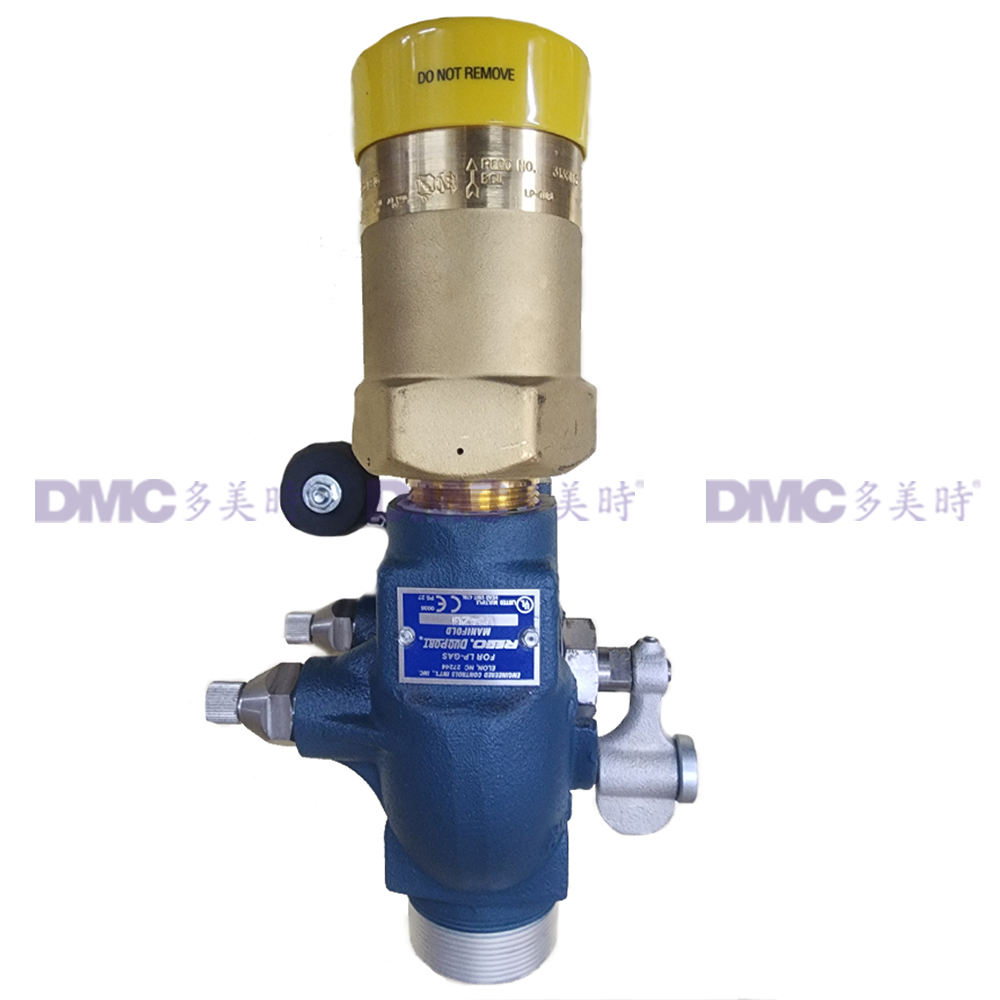
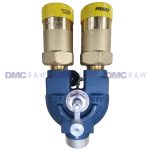
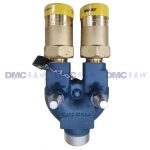
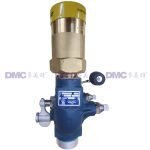
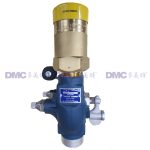

Pressure Relief Valve Manifold for Storage Containers: RegO DuoPort 8542G
Brand: REGO
Model: 8542G HOT
Interface size: 2 “NPT
Connection method: threaded connection
Valve body material: ductile iron
Set pressure: 250psi
Applicable medium: LPG

Description
The RegO DuoPort 8542 Series is a pressure relief valve manifold designed as the primary relief device on smaller stationary LP-Gas and anhydrous ammonia storage containers with 2 in. NPT threaded couplings. Each manifold carries two relief valves, and the operating lever lets you close off the entrance port to either valve and remove it for service while the remaining valve keeps protecting the container — so relief valve replacement never requires evacuating the tank or interrupting service. Three part numbers are published: the 8542G for LP-Gas at 250 PSIG (UL rated 5,250 SCFM air at 120% of set pressure), and the AA8542UA250 and AA8542UA265 for anhydrous ammonia at 250 and 265 PSIG (UL 6,430 / 6,615 SCFM, ASME 6,341 / 6,703 SCFM). Both relief valves are ASME rated for LP-Gas and anhydrous ammonia, and the assembly carries a 10-year RegO warranty.
What the DuoPort 8542 Series Is and Where It Is Used
A relief valve manifold solves a maintenance problem that a single relief valve cannot. On a stationary storage container, the primary relief valve is a safety device that has to be inspected, tested, and periodically replaced — but a conventional installation offers no way to remove that valve without first emptying the vessel. Evacuating a storage container to change a relief valve means lost product, downtime, and a re-commissioning procedure, which is exactly the kind of cost that pushes periodic replacement later and later.
The DuoPort 8542 Series eliminates that trade-off. Two relief valves are mounted on a common manifold with a single 2 in. NPT container coupling. An operating lever lets the operator selectively close off the entrance port to whichever relief valve is being removed, while the other valve continues to protect the container and its contents. Relief valve removal and replacement become routine periodic maintenance instead of a shutdown event.
The series is intended for smaller stationary storage containers — the vessel class below the large bulk installations served by higher-capacity manifolds — and RegO lists it under bulk storage applications and the agriculture and energy & power markets. It is used with both LP-Gas and anhydrous ammonia, which is why the ordering table splits into LP-Gas and NH3 part numbers.
Key Features and What They Mean in Service
- Relief valve removal and replacement without shutting down or evacuating the container. This is the defining benefit of the product. Periodic valve replacement becomes a maintenance task rather than a production event.
- Unique seat ring assemblies with a smooth tubular section. The geometry reduces turbulence through the manifold, which is what protects flow capacity against friction loss — the mechanism behind the assembly-level rating described above.
- An operating lever that locks only in the mid-position or in a position to seal either relief valve. This is a safety-critical design detail, not a convenience. If the clapper disc is left in an intermediate position, flow through one of the relief valves can be restricted, causing that valve to chatter — and chatter destroys the resilient seat disc. The lever’s limited travel positions exist to make the intermediate state impossible to leave the manifold in.
- A rubber plug with chain to protect the manifold outlet threads. When a relief valve is removed, the exposed outlet thread is vulnerable to damage and contamination. The captive plug protects the thread so the replacement valve seats correctly.
- “Pop-action” design. The relief valves open decisively at moderately excessive pressures, giving maximum protection with only minimal product loss.
- Resilient relief valve seat disc for a “bubble-tight” seal. After a discharge event the valve re-seals tightly rather than weeping product.
- ASME rated for LP-Gas and anhydrous ammonia. Both service media are covered by the relief valve rating.
| Product type | DuoPort pressure relief valve manifold for small storage containers |
| Series | 8542 |
| Container connection | 2 in. M.NPT (threaded coupling) |
| Relief valves per manifold | 2 |
| Relief valve inlet connection | 1-1/4 in. M.NPT |
| Pipeway adaptor outlet | 2 in. F.NPT |
| Overall width | 6 1/4 in. |
| Overall height (approx.) | 11 1/16 in. |
| Manifold body material | Ductile iron |
| Clapper disc / bleeder valve | Stainless steel |
| Manifold seat disc | Teflon |
| Packing | Polyethylene |
| Relief valve body | Forged aluminum (coated inlet threads) |
| Relief valve spring | Coated steel |
| Relief valve seat disc | Resilient synthetic rubber |
| Certification | UL Listed; relief valves ASME rated for LP-Gas and anhydrous ammonia |
How to Select the Right DuoPort Manifold
- Identify the medium. LP-Gas → 8542G. Anhydrous ammonia → AA8542UA250 or AA8542UA265.
- Confirm the required start-to-discharge setting. 250 PSIG for the 8542G; 265 PSIG for the AA8542UA265 and AA8542UA250.
- Confirm the container coupling. 2 in. NPT on all three part numbers.
- Establish the required relieving capacity and the rating basis. Take the figure required by your code — UL or ASME — and use the matching column on the correct row.
- Apply the one-valve basis and the accessory derating. The published rating already assumes a single relief valve flowing; if a pipeway adaptor is fitted, the effective flow is lower again.
- Check the physical envelope. 6 1/4 in. wide, approximately 11 1/16 in. tall, with space to remove a relief valve for service.
- Order the matching replacement relief valve and adaptor. 3135MG with adaptor 3135-10 for the 8542G; AA3135MUA250 or AA3135MUA265 with adaptor AA3135-10 for the ammonia versions.
Frequently Asked Questions (FAQ)
What is a DuoPort relief valve manifold?
It is an assembly that mounts two pressure relief valves on a single manifold body, using one container coupling. Its purpose is to let you remove, service, or replace either relief valve without shutting down and evacuating the container.
How can a relief valve be removed without evacuating the container?
The operating lever selectively closes off the entrance port to the relief valve being removed, while the remaining valve continues to protect the container and its contents.
What connection sizes does the 8542 Series use?
A 2 in. M.NPT container connection, a 1-1/4 in. M.NPT inlet on each relief valve, and a 2 in. F.NPT outlet on the pipeway adaptor.
What set pressures are available?
250 PSIG on the 8542G (LP-Gas) , and 265 PSIG on the AA8542UA265 (anhydrous ammonia) and the AA8542UA250 (anhydrous ammonia).
What is the flow capacity of each part number?
At 120% of set pressure: the 8542G is rated 5,250 SCFM air (UL) with no ASME rating published; the AA8542UA250 is rated 6,430 SCFM (UL) and 6,341 SCFM (ASME); the AA8542UA265 is rated 6,615 SCFM (UL) and 6,703 SCFM (ASME).
Why is the flow rating based on one relief valve when the manifold holds two?
Because the critical case is the one where a valve has been removed for service and only the remaining valve is protecting the container. The rating also accounts for friction loss through the manifold, so it is an assembly rating rather than a bare valve rating.
Can the manifold be used with anhydrous ammonia?
Yes. The AA8542UA250 and AA8542UA265 are the ammonia part numbers, and the relief valves are ASME rated for use with LP-Gas and anhydrous ammonia.
What does “NA” mean in the ASME column for the 8542G?
No ASME rating is published for the LP-Gas part number in that row; it carries a UL rating only. If your application requires an ASME-rated capacity on LP-Gas service, confirm the requirement with the manufacturer before specifying.
Where should the operating lever be positioned?
Only in the mid-position or in a position that seals one relief valve. Leaving the clapper disc in an intermediate position can restrict flow through one relief valve, causing it to chatter and destroy the resilient seat disc.
What materials are used in the assembly?
The manifold has a ductile iron body with a stainless steel clapper disc and bleeder valve, a Teflon seat disc, and polyethylene packing. Each relief valve has a forged aluminium body with a special coating on the inlet threads to minimise electrolytic action, an aluminium spring guide, a coated steel spring, and a resilient synthetic rubber seat disc.
Additional information
| Brand |
RegO |
|---|
